The HKUST Office of Knowledge Transfer is excited to showcase our groundbreaking research and pioneering projects at the Hong Kong International Biotechnology Convention, held at HKCEC from 13 to 16 September!
The BIOHK 2023 exhibition serves as an excellent opportunity for us to demonstrate HKUST’s commitment to pushing the boundaries of scientific knowledge and advancing the frontiers of biotechnology. Our cutting-edge solutions cover different aspects such as cancer treatment with sonic hedgehog secretion control, a new option for replacing HPLC, a portable rapid DNA test device, a new solution that can triple the mRNA vaccine efficacy via tailored tail sequence, and more!
Click HERE to learn more about our pioneering biotech projects.
About The Hong Kong University of Science and Technology The Hong Kong University of Science and Technology (HKUST) (https://hkust.edu.hk/) is a world-class research intensive university that focuses on science, technology and business as well as humanities and social science. HKUST offers an international campus, and a holistic and interdisciplinary pedagogy to nurture well-rounded graduates with global vision, a strong entrepreneurial spirit and innovative thinking. Over 80% of our research work were rated “Internationally excellent” or “world leading” in the Research Assessment Exercise 2020 of Hong Kong’s University Grants Committee. We were ranked 3rd in Times Higher Education’s Young University Rankings 2022, and our graduates were ranked 23rd worldwide and among the best from universities from Asia in Global Employability University Ranking and Survey 2021.
Board chairman Jonathan Symonds says master plan for storing health data needed to help Hong Kong become life science ‘super connector’
While Hong Kong can draw upon pool of life science knowledge in Greater Bay Area, strategy must link pieces together, he adds
Hong Kong will need a “proper strategy” for integrating health data to promote itself as a biomedical hub, the chairman of global pharma giant GSK has said, as he recognised the Greater Bay Area’s potential to create a data-led science ecosystem.
Jonathan Symonds, board chairman of the British-based group, on Wednesday said a master plan for storing health data should be drafted to help Hong Kong become a life science “super connector” between mainland China and the rest of the world.
“It is a proper strategy for integrated data, for both clinical application and diagnostic and research, and with tissue and blood banks that support it to be able to do functional genomics,” he said.
“The lifeblood of the future industry is going to be through the application of science to data, not the application of data to biology.”
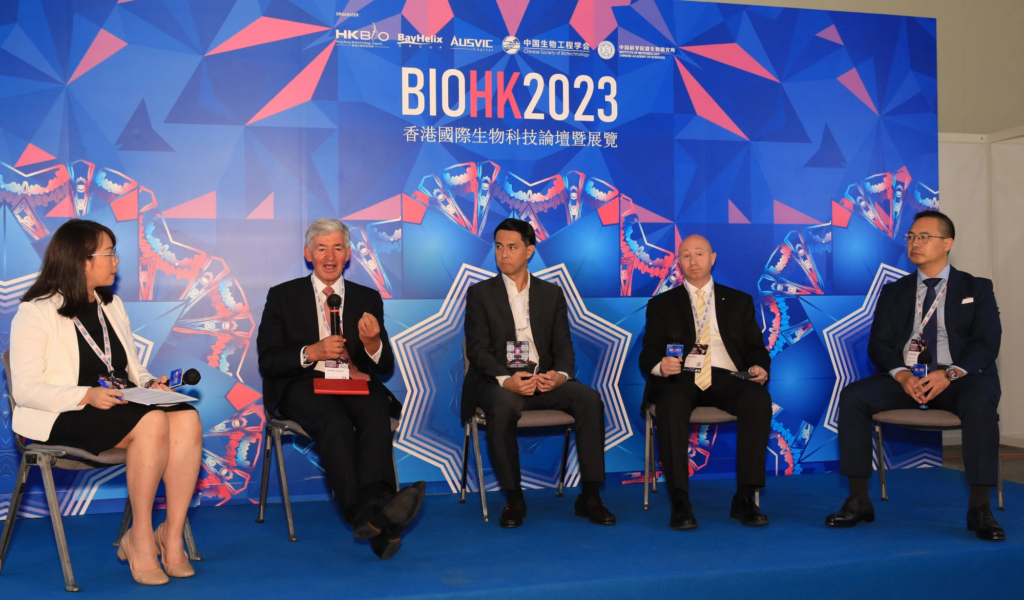
Jonathan Symonds (second left) co-chaired the external advisory board for UK Life Sciences Vision in 2021, the British government’s 10-year strategy for the healthcare industry to speed up innovations. Photo: SCMP
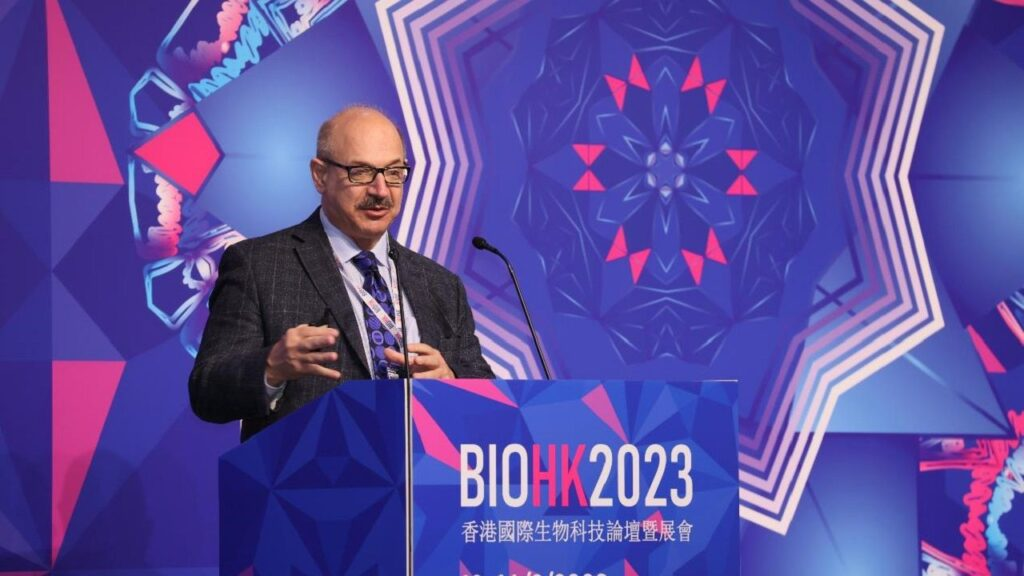
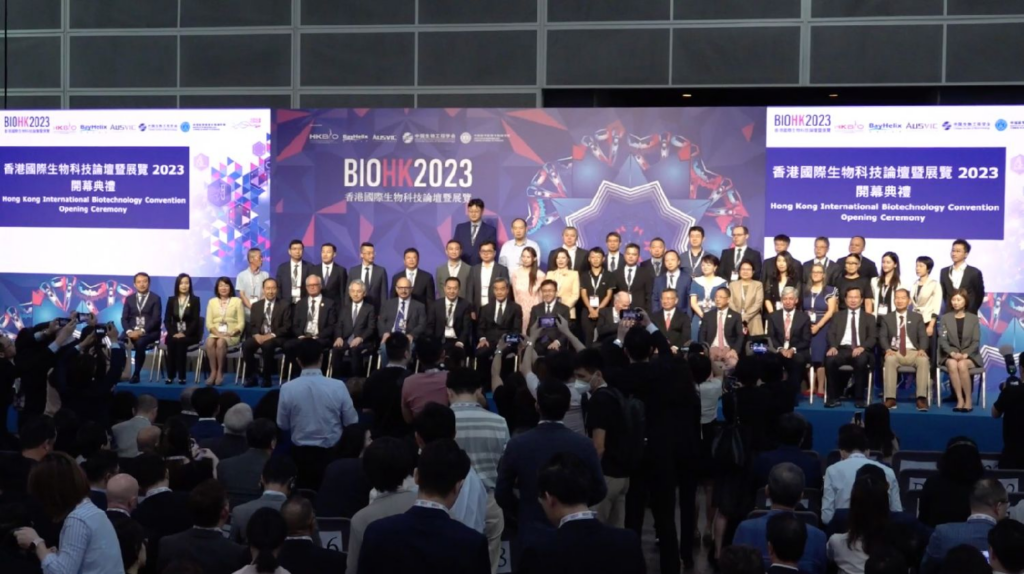
Symonds was speaking at BIOHK 2023, a four-day biotechnology and life sciences conference held at the Hong Kong Convention and Exhibition Centre in Wan Chai. He is experienced in international finance, life sciences and governance, having previously served as the deputy group chairman of HSBC Holdings from 2018 to 2020.
He said a rich set of health data could help pave the way for improvements in making diagnoses and the development of artificial intelligence and digital tools for use in genomic medicine.
But a “very significant investment” would be needed, he added.
The government listed life and health technology as one of the industries for further development under the Innovation and Technology Development Blueprint unveiled in December last year. Hong Kong already plays a key role in this field in the Greater Bay Area, an emerging economic powerhouse combining nine cities in Guangdong province with Hong Kong and Macau.
Symonds co-chaired the external advisory board for UK Life Sciences Vision in 2021, the British government’s 10-year strategy for the healthcare industry to speed up innovations that benefit patients.
He said the British government had launched a large research programme to build a data set of 10 to 20 per cent of the country’s population with “deep phenotyping and genotyping”.
Phenotype refers to observable characteristics or traits and genotype to a set of genetic material.
“[We will have] the ability to track these people through their lives, the ability to look at the disease map across the UK, to be able to identify what the disease map of the UK looks like, where interventions are necessary,” he said.
By using the programme’s data, cost-effective pathways for care could be further developed, reducing the burden on the healthcare system, Symonds said.
Three fundamentals were needed to create a health system that supported modern science – world-class science supported by health data, access to new treatments and technologies, and support from a thriving business environment, he noted.
The bay area had four types of assets based on those fundamentals – its status as a research powerhouse, available health data, hubs of innovation and access to capital, but gaps among them had to be closed to build a data-led science ecosystem, he argued.
“But I think what we’ve learned in the UK is [that it is] not just enough to have these pieces,” he said.
A strategy was needed that brought them together, ensuring the attributes were taken together as a whole and exceeding the individual components, he added.
“What industry needs, what businesses need is access to scientific excellence,” he said. “It needs immediate access to the data sets. It needs access to tissue to allow the ability to do genomics and functional genomics.”
Symonds suggested that Hong Kong should ensure its scientific infrastructure was able to cater to the needs of different companies, regardless of their scale, years of experience or origin, “to be able to access the science base through academic collaborations, to be able to do some of the deep scientific work around genomics … to move towards clinical trials, regulatory processes”.
“These all need to be seamlessly sewn together,” he said. “And this is not a conceptual plan. This does require a lot of hard work.”
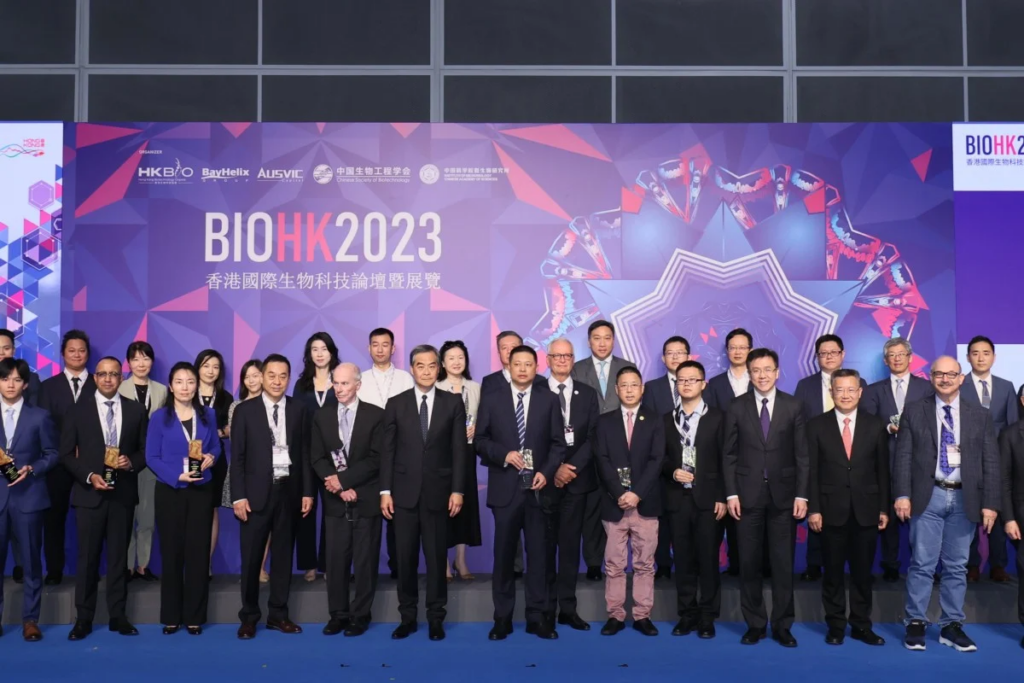
BIOHK2023香港國際生物科技論壇暨展覽將於明日起,一連四日(9月13-16日)於灣仔會展舉行,是向全世界展示亞洲生物科技前沿技術及高端產品的絕佳平台和窗口。大會今屆邀得2011年諾貝爾獎得主Dr. Bruce Beutler教授參與,分享抗衰老的奧秘。活動更有超過200位來自世界各地的專家學者,帶來衰老、癌症、傳染疾病及中藥等,有如「萬花筒」般的生物科技話題,為參加者開啟嶄新視野。
諾貝爾得獎者首日登場
Dr. Bruce Beutler教授是一位美國免疫學家和遺傳學家,2011年憑藉「關於激活先天免疫的發現」獲得諾貝爾生理學或醫學獎。近年,他的實驗室還開發了自動減數分裂圖譜(Automated Meiotic Mapping, AMM)平台,令克隆(clones)定位成為實時程序。BIOHK2023主席于常海教授表示,通過實驗發現在小老鼠身上注入不同癌細胞,都不會令小老鼠患癌,這項研究令對抗癌症及抗衰老取得突破性進展,有機會改變人類健康,實現活到150歲。


 English
  Chinese